
Introduction
Celebrate 100 years of Radio in South Africa
Over the past 30 years, Community radio in South Africa has been a growing and established sector, however, today’s digital transformation has brought opportunities and disruption to an ever changing broadcast landscape. The coming together of the radio medium, the internet, social networking sites and portable devices have steered South Africa’s community radio stations into a process of change (Bosch 2017:125).
Research Question
The research question asks: “How is Community Radio responding to digital transformation in the changing broadcast environment of South Africa?”. Questions draw empirical material from three interconnected areas of response:
+ the lens of production tools and content generation
+ the lens of audience participation and social media
+ the lens of consumption patterns and transmission
Research Problem
New media and innovations in digital technologies have fundamentally changed the way people use media, access information and source entertainment. Traditional radio, influenced by digital innovations and new media, is in the process of change. The fluidity of radio and its links with
new media extend the mediums range and potential (Gunneret al 2011:1).
Purpose of the study
The purpose of this study is to examine the response to digital changes and innovations in the broadcast environment from the vantage point of the Community radio sector in South Africa. To what extent is community radio remains rooted in a mono-medium? Indicators to their responsiveness include studio technology; podcasts; online streams; interactive websites; dedicated mobile apps; consumption patterns; user participation and social media platforms.
Literature
This thesis is broadly located within the discourse and theoretical framework of community, convergence, public sphere and the political economy. These theories inform the study on how community radio is responding to the bringing together of different media, increasing audience involvement and listener participation and the utilization of digital resources across urban and rural-based stations.
Methodology
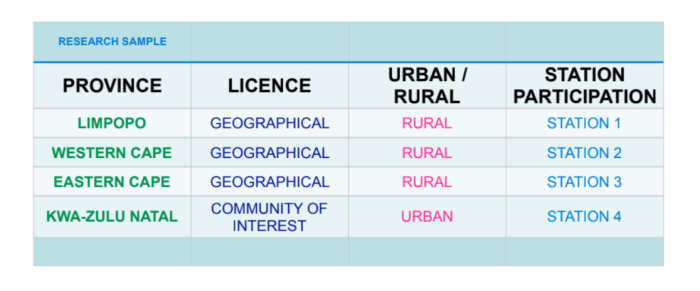
This study is qualitative in nature and aligned with the constructivist paradigm. Constructivism is based on constructed realities, interaction with participants and is rich in description. Of the nine provinces which make up South Africa, fieldwork was conducted in four provinces with a single station in each province. The researcher engaged in selected real-life situations with four (4) community radio stations located in Kwa-Zulu Natal, Western Cape, Eastern Cape and Limpopo.
Discussion
Where does Community radio fit in the digital puzzle?
Data collected from the sampled stations demonstrate Community radio continues to shape the way broadcast content is created, distributed and consumed in a changing digital era.
+ Integration of studio technologies
+ Interactive and participatory media
+ Cross-platform availability
+ Digitizing content
+ Audience empowerment
+ User participation
+ New listening patterns
+ New consumption habits
+ Terrestrial broadcasts
Conclusions
In summary the research concludes digital technologies have altered the relationship between on-air presenters and audience
members to include immediacy and interactivity, anytime and anywhere broadcasting. Evidence collected shows social media and audience participation have elevated audiences from passive listeners to active consumers. On-Air Studios have shifted away from analogue equipment, adapting to fully digitized studios gaining traction and reach within the broadcast space. Although radio transmission and programme consumption have been altered by convergence, it seems that terrestrial broadcasts and listening to radio devices remain the preferred choice by broadcasters and audience members respectively.
The main benefits of digital opportunities:
+ New production tools and a digital studio infrastructure have played a central role in processing programme delivery, speedily accessing content and breaking news.
+ New media and audience participation have elevated audience involvement from passive listeners to active consumers.
+ The linear relationship of traditional radio has been broken by the Internet.
+ To some degree all sampled stations offer online streaming, podcasting, social media platforms, a mobile app, visual content and interactive websites.
+ Audiences have a vast selection of content choices across different platforms. Audiences have more choice in the way they listen to radio. Here are some responses:
+ FM (Frequency Management) remains the main distribution platform. Sampled stations demonstrate a foothold in terrestrial broadcasting.
The main challenges:
+ How can community radios’ pluralistic function be
recognized?
+ How can community radios’ social, economic and
distribution sustainability be assured?
+ How can community radios’ contribution to public good be
further demonstrated?
Bibliography
Bosch, T. (2017) Broadcasting Democracy, Cape Town, HSRC Press
Broadcast Research Council RAMS REPORT (BRC RAMS Jul’18 – Dec’18; Jan’19 – Jul’19)
https://brcsa.org.za/category/radio-audience-trends/ (Retrieved 11 July 2018 and 13 June 2019)
Duncan J. (2012) A Political Economy of South Africa Digital Broadcast Transition
Gagliardone, I et al (2012) New communication technologies and citizen-led governance in Africa, Publisher: Centre of Governance and Human Rights, University of Cambridge
email cghr@polis.cam.ac.uk (Retrieved 20 September 2020)
Gazi A, Starkey G, Jedrzejewski S. (2011) Radio Content in the Digital Age, Bristol, UK
Gunner, L. Ligaga, D. Moyo, D. (2011) Radio in Africa: Publics, Cultures, Communities, Johannesburg Wits University Press
Kruger, F; Monji, R; and Smurthwaite, M (2013): The Healthy Community Radio Station – Wits Radio Academy, OSISA
Kupe. T (2014) Media Diversity Media Landscape 2014 Celebrating 20 years GCIS (Dept of Communications), Pretoria
Latzer, M (2013) Media Convergence: Working Paper of Media Change and Innovation
https://www.mediachange.ch/media/pdf/publications/Latzer2013_Convergence.pdf (Retrieved 11 April 2018)
Mertens, D. M. (2015). Research and Evaluation in Education and Psychology. Sage
Publications. https://study.sagepub.com/mertens5e (Retrieved 1 June 2018)
Mosco, V (2009) The Political Economy of Communication: Rethinking and Renewal. London, Sage.
Mtimde L, (2014) Media Landscape 2014. Twenty years of media development and diversity GCIS (Dept of Communications), Pretoria
NAB (2019) State of Broadcasting Industry Report (Report) https://www.nab.org.za/uploads/files/NAB_Report_2019.pdf (Retrieve 2 September 2019)
NAB (2019) Future Proofing Community Radio (Guide) https://www.nab.org.za/uploads/files/NAB_Future_Proofing_Guide_for_Community_Radio.pdf (Retrieve 29 August 2019)
Quebral, N (2012) The Underside of Development Communication https://www.nordicom.gu.se/sites/default/files/kapitel-pdf/362_quebral.pdf (Retrieved 23 August 2019)